Choosing the right garage door paint can be surprisingly difficult. A garage door is often one of the largest visible features on the front of a home, so its color can influence the appearance of the entire exterior.
The most common question homeowners ask is whether the garage door should match the house color or the trim. The answer is that it does not have to match either one exactly. Instead, the best choice depends on the relationship between your siding, trim, roof, front door, windows, landscaping, and architectural style.
Matching the garage door to the house can create a subtle, unified appearance. Matching it to the trim can give the exterior more definition. A contrasting neutral can also work when you want the garage door to become a deliberate architectural feature.
For homeowners in Wichita and surrounding Kansas communities, the practical side of garage door painting matters as well. Sun exposure, temperature changes, wind, moisture, and the existing condition of the surface can all affect how an exterior coating performs.
This guide explains how to choose garage door paint based on your home’s existing color scheme and how to approach the painting process.
Garage Door Paint: Why Color Coordination Matters
A garage door can occupy a large portion of a home’s front elevation. Because of its size, even a small color difference can become highly noticeable.
That does not mean the garage door needs to disappear into the exterior. Instead, think about the overall visual balance.
Before choosing a color, consider:
- The primary siding or exterior color
- Window and door trim
- Roof color
- Front door
- Shutters
- Brick or stone
- Exterior lighting
- Landscaping
- Architectural style
- Amount of direct sunlight
The goal is to create a color relationship that looks intentional.
For example, a white garage door may work well with white trim and light siding. A charcoal garage door may provide attractive contrast against a white or light-gray house. A warm brown door can complement brick, stone, or other earthy materials.
There is no single universal rule. The right garage door paint depends on the colors and materials already present.
Should Your Garage Door Match Your House Color?
Matching the garage door to the main house color is one of the simplest approaches.
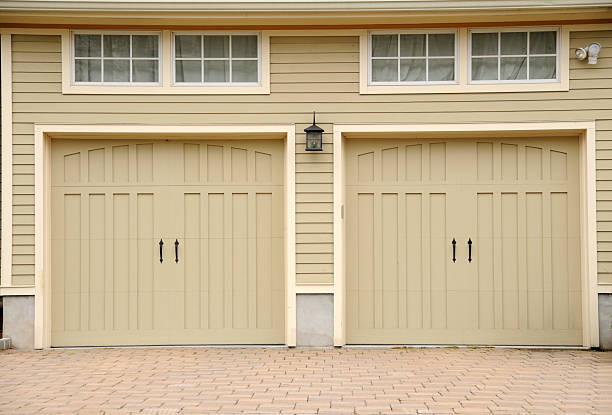
If your home has a neutral exterior, using a similar color on the garage door can make the entire facade feel cohesive. This can be especially useful when the garage door is large or positioned prominently at the front of the property.
When Matching the House Works
Matching or closely coordinating the garage door with the siding can be useful when you want the door to blend into the architecture.
For example:
- White siding can pair with white or soft-white garage paint.
- Gray siding can work with a similar gray or a slightly darker shade.
- Beige siding can coordinate with taupe, cream, or warm beige.
- Blue siding can work with a related blue-gray or neutral shade.
- Green siding can pair with muted green, gray, or earthy neutrals.
This approach reduces visual contrast and can make the garage door less dominant.
When Contrast Is Better
Matching the house is not always the best option.
If your home’s exterior is very light, a darker garage door can add definition. Similarly, if the house already has several strong colors, matching the siding exactly may create too much visual sameness.
For example, a light-gray house with a charcoal garage door can create a clean contrast without introducing a completely unrelated color.
The important consideration is whether the contrast connects to another feature of the home.
Should Your Garage Door Match the Trim?
Matching the garage door to the trim is another common design approach.
Trim includes elements such as window frames, fascia, columns, porch details, and other architectural accents. When the garage door shares the trim color, these features can visually connect with one another.
Creating a Coordinated Exterior
Suppose a house has:
- Light beige siding
- White window trim
- White columns
- A white garage door
The garage door becomes part of a larger white trim system rather than appearing as an isolated feature.
This can be particularly effective on traditional and transitional homes.
However, the garage door does not have to match every trim element exactly. A related shade can create a softer transition.
For example, warm white trim could be paired with an off-white garage door rather than an extremely bright white.
When Matching the Trim May Not Be Ideal
If the trim is already a strong accent color, using the same color on a large garage door could make the door visually overpowering.
Imagine a home with dark navy trim around every window. Painting a large garage door the same navy could create a dramatic appearance, but it may be more visual contrast than the homeowner wants.
In such cases, a neutral garage door can balance the stronger trim.
House vs. Trim Which Garage Door Color Is Better?
There is no universal winner between matching the house and matching the trim.
Use the following comparison as a starting point:
| Garage Door Approach | Visual Effect | Best For |
| Match the house | Blends into exterior | Homes where the garage should be subtle |
| Match the trim | Creates coordination | Traditional and balanced exteriors |
| Darker neutral | Adds contrast | Light-colored homes |
| Lighter neutral | Softens contrast | Dark or strongly colored exteriors |
| Accent color | Makes the door stand out | Homes with simple exterior palettes |
| Wood-tone color | Adds warmth | Brick, stone, and natural materials |
A useful rule is to ask: Do I want my garage door to blend in or stand out?
If you want it to blend in, matching or closely coordinating with the siding is usually the logical starting point.
If you want it to feel like part of the home’s architectural detailing, matching the trim may be more appropriate.
If you want a stronger visual feature, consider a contrasting but complementary color.
How to Choose Garage Door Paint Based on Exterior Features
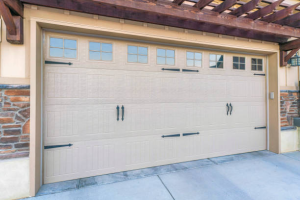
The garage door should be evaluated as part of the entire exterior.
Consider the Siding
The siding is usually the largest color surface on the house, making it an important reference point.
With light siding, you have more freedom to use either a matching neutral or a darker contrast.
With dark siding, a lighter garage door can prevent the front of the house from becoming visually heavy.
Look at the Trim
Identify whether your trim is warm, cool, light, or dark.
Warm white, cream, beige, and tan trim generally work well with warm garage door colors. Cool whites and blue-gray tones may pair better with cooler grays or similar shades.
Consider the Roof
The roof is easy to overlook because it is above eye level, but it still contributes to the home’s overall color palette.
A dark gray roof may coordinate with charcoal or black garage paint. Brown roofing can work well with brown, taupe, cream, or other warm neutrals.
The garage door does not need to match the roof. It simply should not clash with it.
Look at the Front Door
The front door can provide inspiration for garage door paint, but the two doors do not necessarily need to match.
If the front door is already a strong accent color, keeping the garage door neutral can maintain balance.
For example, a red or blue front door can work with a white, gray, charcoal, or natural-looking garage door.
Consider Windows and Shutters
Dark window frames or shutters can provide a useful reference for choosing a darker garage door.
If the home has black window frames, a black or charcoal garage door can repeat that color elsewhere on the facade.
This creates consistency without requiring the garage door to match the siding.
Pay Attention to Brick and Stone
Brick and stone contain multiple tones, so matching them exactly can be difficult.
Instead, identify the dominant undertones.
For warm brick, consider:
- Brown
- Cream
- Beige
- Taupe
- Charcoal
For cooler stone, consider:
- Gray
- Slate
- Black
- Blue-gray
- Soft white
The objective is coordination rather than exact duplication.
Best Garage Door Color Combinations
Different exterior combinations can create very different results.
White House With Dark Garage Door
White siding with charcoal or black garage paint creates strong contrast. This can work especially well when the home also has dark window frames, lighting fixtures, or shutters.
Gray House With White Garage Door
A white garage door against gray siding creates a clean and traditional appearance. It can also connect with white trim around windows and doors.
Beige House With Brown Garage Door
Brown can complement warm beige siding, brick, stone, and wood accents.
Navy introduces color while remaining relatively restrained. It can work especially well when the front door or shutters use related blue tones.
Brick House With Charcoal Garage Door
Charcoal can provide contrast without competing with the natural variations found in brick.
Stone Exterior With Taupe Garage Door
Taupe can bridge the gap between gray and brown, making it useful for homes with mixed stone colors.
Light vs. Dark Garage Door Paint
The choice between light and dark paint is partly aesthetic and partly practical.
Advantages of Light Garage Door Colors
Light colors can:
- Create a softer appearance
- Reduce visual weight
- Coordinate easily with light siding
- Provide a classic appearance
- Reflect more sunlight than very dark colors
White, cream, light gray, and beige are common choices.
Advantages of Dark Garage Door Colors
Dark colors can:
- Create stronger contrast
- Highlight the garage as an architectural feature
- Coordinate with dark windows
- Complement modern exterior designs
- Add depth to a light-colored home
Black, charcoal, navy, and dark brown are examples.
However, darker colors may absorb more solar energy than lighter colors. The effect depends on the door’s material, construction, orientation, coating, and local conditions. Always follow the garage door manufacturer’s recommendations when selecting a coating.
Choosing Garage Door Paint for Wichita and Kansas Homes
Homeowners in Wichita need to consider more than color when planning an exterior painting project.
Kansas weather can expose exterior surfaces to strong sunlight, wind, rain, and temperature fluctuations. These conditions can contribute to fading, chalking, cracking, peeling, and other coating problems over time.
This makes surface preparation an important part of garage door painting.
Before applying new garage door paint, inspect the existing surface for:
- Peeling or flaking paint
- Cracks
- Chalking
- Rust
- Dirt and mildew
- Previous coating failure
- Damaged areas
Bolden’s Painting Co is a family-owned painting company serving Wichita and surrounding Kansas communities. Its website states that the company has more than 30 years of experience and provides residential and commercial painting services, including interior and exterior repainting.
The company lists Wichita, Derby, Andover, Newton, Rose Hill, Goddard, Valley Center, El Dorado, Park City, and Maize among its service areas.
For homeowners researching garage door painting as part of a larger exterior project, understanding the local environment and surface condition can help determine the appropriate preparation and coating approach.
Common Garage Door Color Mistakes
Choosing a Color in Isolation
A paint chip may look appealing by itself but appear different when placed beside your siding or brick.
Always compare the color with the actual exterior.
Ignoring Undertones
A gray with blue undertones can look noticeably different from a warm gray with beige undertones.
The same principle applies to white, beige, green, and other neutral colors.
Automatically Matching the Front Door
The garage door and front door can coordinate without being identical.
A strong accent front door can actually look better when paired with a quieter garage color.
Choosing an Extremely Dark Color Without Testing
Black and very dark colors create significant contrast. Test them in natural light before painting the entire door.
Skipping Surface Preparation
A good color cannot compensate for peeling, dirty, or poorly prepared surfaces.
Proper preparation helps the new coating adhere and can contribute to a more consistent finish.
Forgetting the Garage Door Material
Metal, wood, vinyl, and other garage door materials may have different preparation and coating requirements.
The paint product should be compatible with the specific surface.
How to Test a Garage Door Color
Testing your chosen garage door paint before committing to the entire surface is a practical way to reduce mistakes.
Follow these steps:
- Narrow your options to two or three colors.
- Obtain physical samples rather than relying only on digital images.
- Test each color on an appropriate small area.
- Observe the samples in morning and afternoon light.
- Check them on cloudy days if possible.
- Compare them with the siding and trim.
- View the colors from the street.
- Consider how they look alongside the roof and front door.
Large exterior surfaces can make colors appear more intense than they do on a small sample.
Garage Door Surface Preparation Before Painting
The preparation process depends on the door’s material and existing condition.
A typical painting process may involve:
1. Inspection
The surface is checked for peeling, cracking, rust, damage, and coating failure.
2. Cleaning
Dirt, dust, grease, mildew, and other contaminants should be removed as appropriate for the surface.
3. Removal of Failing Paint
Loose or peeling paint should be addressed before new coating is applied.
4. Sanding and Repairs
Depending on the material, sanding and minor surface repairs may be necessary.
5. Primer
Some surfaces and color changes may require primer. Product specifications should determine which primer is appropriate.
6. Paint Application
The selected garage door paint should be applied according to the manufacturer’s instructions, including recommended temperature, drying time, and number of coats.
Bolden’s Painting Co describes its approach as preparation-focused, with repainting, restoration, and surface preparation forming part of its painting process.
When to Repaint a Garage Door
There is no fixed schedule that applies to every garage door.
Instead, inspect the coating regularly and look for visible signs of deterioration.
These can include:
- Fading
- Peeling
- Cracking
- Chalking
- Flaking
- Rust
- Exposed substrate
- Uneven color
- Previous patch repairs
If the coating is failing, repainting may be appropriate after the underlying surface has been properly evaluated and prepared.
The timing can also depend on sun exposure, weather conditions, the quality of the previous paint job, the material of the garage door, and the type of coating used.
Garage Door Painting in Wichita: What to Consider
A garage door repaint can be a standalone project or part of a larger exterior update.
If the home’s siding, trim, fascia, shutters, or other exterior elements are also being repainted, it may make sense to evaluate all of the colors together rather than choosing the garage door color independently.
Bolden’s Painting Co provides residential exterior painting and other painting services in Wichita and surrounding communities. Its listed services include exterior repainting along with specialty services such as stucco repainting, vinyl repainting, cabinet refinishing, deck refinishing, fence staining, and concrete staining and sealing.
For a property owner planning multiple exterior surfaces, discussing the materials, existing coatings, and desired color scheme can help determine which preparation and painting methods are appropriate.
Conclusion
It can match either, but it does not have to. Matching the house color can help the garage door blend into the exterior, while matching the trim can connect it to the home’s architectural details. A contrasting neutral can also create a defined focal point without making the exterior feel disconnected.
Start by looking at the entire color palette, including siding, trim, roof, windows, front door, brick, stone, and landscaping. Then decide whether you want the garage door to blend in or provide contrast.
For Wichita homeowners, also consider sunlight, weather exposure, surface condition, and the garage door material before selecting garage door paint. Proper preparation is just as important as color selection when the goal is a consistent and durable finish.
Bolden’s Painting Co serves Wichita and nearby Kansas communities with residential and commercial painting services. If you are planning a garage door repaint or a broader exterior update, contact us to discuss your project and determine the appropriate next steps.
FAQ Garage Door Paint
Should a garage door match the house color?
It can, but it does not have to. Matching the house color helps the garage door blend into the exterior, while a contrasting color can create more visual definition.
Should a garage door match the trim?
Matching the trim is a common design approach because it connects the garage door with other architectural details. However, a coordinated or contrasting shade can work just as well depending on the home’s exterior.
What is the best color for a garage door?
There is no single best color. White, gray, black, beige, brown, navy, and other neutral or muted colors can work depending on the siding, trim, roof, architectural style, and surrounding materials.
Should my garage door match my front door?
Not necessarily. The two doors can match, but they can also use complementary colors. If the front door is a strong accent color, a neutral garage door may create better overall balance.
What color garage door looks best with a gray house?
White, charcoal, black, medium gray, and navy can work well with gray homes. The undertone of the existing gray siding should be considered before selecting the garage door paint.
What garage door color works with a brick house?
Brown, charcoal, black, cream, taupe, and muted green can complement brick. Look at the brick’s underlying tones rather than trying to match the brick exactly.
Does dark garage door paint absorb more heat?
Generally, darker colors absorb more solar energy than lighter colors. The actual effect depends on the garage door material, construction, orientation, coating, and exposure.
How do I choose between matching my house and matching my trim?
First decide whether you want the garage door to blend in or stand out. Match or closely coordinate with the siding if you want a subtle appearance. Coordinate with the trim if you want the garage door to connect with architectural details.
How do I know if my garage door needs repainting?
Look for fading, peeling, cracking, chalking, rust, flaking, or exposed material. These signs indicate that the existing coating may need attention.
Can any paint be used on a garage door?
No. The appropriate coating depends on the garage door’s material, existing finish, condition, and manufacturer’s recommendations. Proper surface preparation and product compatibility should be considered before painting.