An outdoor deck is the heartbeat of a backyard during Kansas summers. It is where you grill burgers with family, relax on quiet weekend mornings, and entertain friends under the open sky. But because decks are built flat, they face constant exposure to weather. Between blazing July heatwaves, humid spring storms, and freezing winter snow, deck boards take a beating. When the boards start to look dull, grey, or worn out, homeowners face a big choice: should you paint your deck or stain it?
Choosing between these two finishes is not as simple as picking a color you like from a store shelf.
Paint and stain interact with natural wood in completely different ways. While paint creates a thick film on top of the boards, stain soaks deep into the wood pores to protect the grain from the inside out. Industry testing shows that moisture damage and foot traffic cause painted horizontal deck floors to peel up to three times faster than vertical painted siding.
If you are planning an outdoor update, choosing the right coating is only one part of the job. Careful pressure washing, thorough sanding, and choosing breathable products all determine how long your deck will last. If you want to see how an experienced crew tackles weathered wood, you can review our deck refinishing services to see how proper prep work restores outdoor spaces.
So, when comparing deck paint vs stain in Wichita, which option really gives you the best value and performance? The answer depends on the age of your wood, the look you want, and how much yearly maintenance you are willing to handle.
Let us look at both options in detail.
How Deck Paint and Deck Stain Actually Work
To make the right choice, it helps to understand what happens when each product touches wood.
How Deck Paint Works
Deck paint is an opaque coating designed to sit on top of the wood surface. Just like exterior wall paint, high-performance acrylic deck enamels form a thick protective barrier. This barrier completely hides the natural wood grain and knots underneath, giving the surface a solid, uniform color.
Because paint forms a solid shell, it acts as a strong sunblock against harmful ultraviolet rays. However, this shell is non-breathable compared to penetrating finishes. If moisture gets trapped under the paint film, that water has nowhere to go. When hot summer temperatures warm up the wood, the trapped moisture expands into vapor, pushing the paint away from the board and causing bubbles and peeling sheets.
How Deck Stain Works
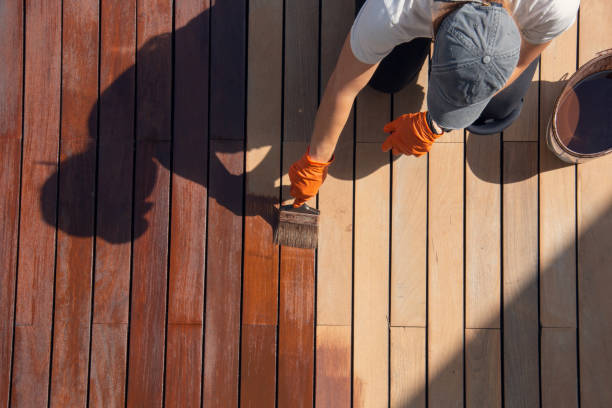
Deck stain is formulated to penetrate directly into the wood grain. Instead of forming a separate skin on the surface, it soaks into the timber fibers and seals them against rainwater.
Stain contains special oils, water-repellent resins, and pigments that allow the natural texture of the wood to show through. Most importantly, penetrating stains leave the wood breathable. When rain soaks through the gaps or moisture rises from the ground below, water vapor can evaporate through the boards naturally without lifting the finish.
Comparing the Main Types of Deck Stains
If you lean toward staining, you will quickly notice that stain comes in several varieties. Each type offers a different balance of natural appearance, UV protection, and longevity.
Clear Sealers and Toners
Clear sealers provide water repellency without altering the natural color of your lumber. Toners add just a hint of warm cedar, redwood, or honey tint.
- Best For: Brand-new premium cedar or redwood decks where you want the natural grain to be the star.
- Main Advantage: Highlights natural grain patterns beautifully without hiding wood knots.
- Main Drawback: Contains very little pigment, meaning it offers minimal protection against sun bleaching. They generally require reapplication every 12 to 18 months.
Semi-Transparent Stains
Semi-transparent stain is the most popular choice for residential decks. It contains subtle color pigments that protect against UV rays while allowing the wood grain and knots to show through.
- Best For: Good-condition pressure-treated pine, cedar, or older decks that still have sound wood fibers.
- Main Advantage: Offers strong moisture resistance and solid UV defense while preserving an authentic wood appearance.
- Main Drawback: Requires reapplication every 2 to 3 years on high-traffic floorboards.
Solid Color Stains
Solid stains look very similar to flat exterior paint. They provide complete, opaque color coverage that hides the wood grain entirely, although you can still feel the physical texture of the wood underneath.
- Best For: Older decks with mismatched boards, dark weathering stains, or light surface cracks.
- Main Advantage: Provides the highest level of UV protection among all stain types, often lasting 3 to 5 years.
- Main Drawback: While it breathes better than paint, it forms a light film that can eventually chip or wear away in heavy walkways.
Comparing Deck Paint vs Stain Side-by-Side
To help you decide which finish fits your home and maintenance habits, here is a direct comparison of how paint and stain stack up across core performance factors:
| Performance Factor | Deck Paint | Deck Stain |
| Primary Mechanism | Forms a solid protective film on the surface. | Penetrates into the wood fibers and seals them. |
| Visible Wood Grain | Completely hidden beneath solid, uniform color. | Visible with clear, toner, and semi-transparent options. |
| Expected Lifespan | 4 to 8 years before major recoating is required. | 2 to 4 years depending on pigment and sunlight. |
| Failure Symptoms | Chips, blisters, cracks, and peels away in sheets. | Fades gradually, thins out, and wears down evenly. |
| Slip Resistance | Can become slippery when wet unless sand texture is added. | Keeps natural wood grain texture for natural traction. |
| Maintenance Effort | High; requires scraping, stripping, and sanding old paint. | Low; requires simple power washing and applying a fresh coat. |
| Color Selection | Nearly unlimited; can match house trim and exterior accents. | Limited to natural wood tones, greys, and earth shades. |
How Wichita Weather Affects Your Deck Finish
Kansas weather presents serious challenges for outdoor wood structures. When evaluating deck paint vs stain in Wichita, you must factor in the extreme seasonal swings our local decks endure every year.
Wichita experiences hot summers with temperatures frequently climbing past 100 degrees, combined with intense ultraviolet sunshine. In winter, temperatures drop well below freezing, accompanied by sleet, ice, and heavy snowstorms. In fact, our region experiences dozens of freeze-thaw cycles every single year.
This constant freeze-thaw cycle is the primary reason why painted deck floors struggle in our climate. Horizontal deck boards hold melting snow for days. That moisture seeps beneath tiny nail gaps or seams. When the water freezes overnight, it expands, cracking the rigid paint shell.
Penetrating stains perform far better during Kansas winters because they do not form a rigid barrier. The wood expands and contracts naturally without breaking a surface film. For homeowners investing in deck staining in Wichita, Kansas, choosing oil-based or hybrid waterborne penetrating formulas is the best way to withstand these weather swings.
When Does Deck Painting Make Sense?
While stain is often the default choice for outdoor wood, painting is not always the wrong answer. There are specific situations where deck painting in Wichita, KS is the smarter path:
- Your Deck Has Already Been Painted: Once a deck has been coated with paint, stripping every square inch of paint out of the deep grain to apply a semi-transparent stain is exhausting and expensive. Sticking with paint is usually the most practical choice.
- The Wood Is Heavily Weathered or Aged: Older pressure-treated decks often develop deep surface checks, splinters, and small cracks. Thick acrylic deck paints fill these small fissures and bridge rough spots, giving old wood a smooth, uniform surface that is barefoot-friendly.
- You Want a Bold or Custom Color: If you want your deck floor to match your home’s dark navy shutters or bright white trim, paint provides complete color flexibility that wood stain cannot match.
- Vertical Railings and Balusters: Vertical surfaces do not hold standing water or endure foot traffic. Using paint on vertical railings while applying stain to horizontal floorboards gives you sharp curb appeal with easy-to-maintain walking surfaces.
When Does Deck Staining Make Sense?
For the majority of Kansas homeowners with natural lumber, staining remains the gold standard for long-term satisfaction. Here is when stain wins:
- You Have Beautiful Natural Lumber: If you invested in cedar, redwood, or high-grade pine, covering that warm, organic grain with opaque paint wastes the natural character of the lumber.
- You Want Low-Stress Maintenance: When a stain job reaches the end of its lifespan, it simply fades and looks dry. You do not have to spend days on your knees with a scraper chipping away peeling flakes. A light wash and a new coat of stain bring it right back to life.
- Moisture Trapping Is a Concern: If your deck is built low to the ground with limited airflow underneath, moisture will constantly rise against the underside of the floorboards. Penetrating stains allow that moisture to evaporate harmlessly.
- Pool Decks and High-Traffic Yards: Paint can become slick when wet, creating a slip hazard near pools or backyard hoses. Stain preserves the natural texture of the wood, providing natural grip underfoot.
Surface Preparation: The Secret to Long-Lasting Finishes
Whether you choose paint or stain, your project will only last as long as your surface preparation. Skipping prep work is the number one reason deck coatings fail early.
Inspecting and Tightening the Deck
Before cleaning, walk the entire deck surface. Tighten loose screws, countersink popped nails, and check the ledger board and support posts for soft spots. Replace boards that show deep cracks or structural decay.
Deep Cleaning and Washing
Decks collect ground-in dirt, barbecue grease, tree sap, and mildew. Start by sweeping the deck clean and clearing out leaves trapped between board gaps.
Apply an oxygenated deck cleaner or specialized stripper to loosen old oil and gray oxidized wood fibers. Wash the cleaner away using a pressure washer fitted with a wide 40-degree fan tip, keeping the pressure between 800 and 1,200 PSI. Never use high pressure close to the boards, as it will gouge the soft summerwood and leave deep furrows in your lumber.
Testing Wood Porosity (The Water Drop Test)
Once the deck has dried completely for at least 48 hours, conduct a simple water test. Splash a few ounces of clean water onto high-traffic sections of the deck:
- If the water beads up into droplets, an old sealant is still present. New stain cannot soak in, and you must sand or strip the surface further.
- If the water absorbs into the wood within a minute or two, turning the boards dark, the wood pores are open and ready to accept fresh stain or primer.
How Bolden’s Painting Co. Restores Wichita Decks
Caring for an outdoor wood deck requires patience, the right equipment, and an honest understanding of local climate challenges.
At Bolden’s Painting Co., our team brings more than 30 years of family-owned craftsmanship and three generations of hands-on experience to homes across Wichita and Sedgwick County. We know that outdoor decks cannot be rushed. A lasting finish demands thorough washing, proper wood drying, detailed sanding, and the right coating application.
Whether your backyard needs a semi-transparent cedar stain or a durable solid coating, our painters use premium products from Sherwin-Williams and Benjamin Moore to deliver lasting protection. We arrive on time, keep your landscaping safe, and stand behind our work with straightforward, honest pricing.
Estimated Deck Refinishing Costs in Wichita
Understanding the costs of deck maintenance helps you plan your backyard budget accurately. Prices depend on the square footage of the deck, whether railings and stairs are included, and how much sanding or stripping is needed. On average, deck refinishing in our area ranges between $2.50 and $5.00 per square foot.
Here is an estimated price guide for common deck projects in our local area:
| Deck Size and Scope | Typical Dimensions | Estimated Cost Range | Estimated Timeline |
| Small Townhome Deck | 10′ x 12′ (120 sq. ft., no stairs) | $450 – $800 | 1 to 2 Days |
| Standard Backyard Deck | 14′ x 20′ (280 sq. ft., floor + railings) | $950 – $1,800 | 2 to 3 Days |
| Large Multi-Level Deck | 400+ sq. ft. (stairs, rails, benches) | $1,800 – $3,500 | 3 to 4 Days |
| Full Paint Strip & Sand | Heavy paint removal down to bare wood | $1,500 – $3,000 extra | 2 to 3 Extra Days |
Note: Final pricing depends on wood condition, access constraints around flowerbeds or swimming pools, and whether you are coating bare wood or stripping off stubborn layers of old, peeling paint.
5 Practical Homeowner Tips to Protect Your Deck
Taking care of your deck between professional service visits adds years to the life of your boards:
- Sweep Leaves and Debris Weekly: Leaves and pine needles that sit in board gaps trap moisture against the wood, creating the perfect environment for mold, mildew, and rot.
- Move Pots and Patio Furniture Seasonally: Heavy planters trap puddles underneath them, leaving dark water rings that rot floorboards. Use raised planter feet or shift furniture around every few months.
- Avoid Using Metal Snow Shovels: In winter, never scrape snow off your wood deck with a sharp metal shovel. Use a plastic shovel or a push broom, and shovel parallel to the wood grain to avoid gouging the finish.
- Never Use Rock Salt on Wood: Chemical de-icers and rock salt draw moisture out of wood fibers, leaving deck boards brittle, cracked, and discolored.
- Wash Your Deck Every Spring: A simple garden hose wash with a mild wood cleaner every spring removes winter road grit and pollen before summer heat bakes it into the coating.
Final Thoughts
Deciding between deck paint vs stain in Wichita comes down to the condition of your wood and how you want to manage your long-term maintenance. Paint offers thick, opaque coverage that can give older weathered wood a smooth, uniform appearance, but it requires serious scraping and sanding when it eventually peels. Stain preserves the authentic grain of your lumber, breathes naturally during Kansas winter freezes, and wears away gradually for simple, hassle-free touch-ups.
Whichever finish you select, taking the time to wash, dry, and prepare the wood properly guarantees that your outdoor living space stays beautiful and safe for your family. If you want an honest assessment of your deck’s condition or need help choosing the right coating, you can contact our team to discuss your project scope and schedule an on-site consultation.
Frequently Asked Questions
Which lasts longer on a deck, paint or stain?
Paint usually lasts longer between full coats, often holding up for 4 to 8 years. However, when paint fails, it peels and requires aggressive scraping. Stain lasts 2 to 4 years but fades evenly, making regular maintenance much simpler.
Can I apply stain over a previously painted deck?
No, penetrating stain cannot soak through paint. If your deck is painted, you must either repaint it with a quality deck enamel or completely strip and sand the wood down to bare timber before applying a semi-transparent stain.
What is the best time of year to stain a deck in Wichita?
Late spring and early autumn offer the best weather for deck staining in Kansas. Moderate temperatures between 50 and 80 degrees, lower humidity levels, and dry forecasts allow oil and waterborne stains to absorb and cure properly.
Why is my deck paint peeling after only one year?
Deck paint peels early when applied over damp wood, unwashed mildew, or dirty surfaces. Moisture trapped beneath the paint film expands during hot summer days, pushing the rigid paint shell away from the wood boards.
Do I need to sand my deck before staining it?
Yes, light sanding is always recommended. Sanding removes loose wood splinters, smooths raised wood grain caused by power washing, and opens up the timber pores so the stain can penetrate deep into the fibers.
Is solid stain the same as deck paint?
Solid stain is very similar to paint in appearance because it completely masks the wood grain. However, solid stain is formulated thinner, allowing it to penetrate deeper into the wood and breathe better than traditional exterior film-forming paint.